sbk.org Arbeitgeberservice Leistungserbringende Karriere Unternehmen SBK Presse & Politik Search
DeutschLogin
Become a member
Become a member Become a member Become a member in one step Employees Families Students Trainees Self-Employed Expats Recommending SBK Awards About SBK Health care in Germany Advice & Services Advice & Services Alternative Medicine SBK Overseas-Plus Personal consultation E-Health Family & Pregnancy Health & treatment Long-Term Care Prevention & health promotion Dental health Alternative Medicine Acupuncture Homeopathy Osteopathy SBK Overseas-Plus SBK International Consulting Travel Insurance EHIC Travel vaccinations Personal consultation SBK Consulting SBK Health Telephone SBK Appointments Service E-Health Apps & digital offers Digital services Electronic prescription SBK Electronic Patient Record SBK Account Family & Pregnancy Treatments for Children Child sickness benefit Pregnancy & childbirth Prevention & precautionary measures for children Health & treatment Incapacity to work (eAU) Medicines & dressings Treatment in surgeries & clinics Glasses & medical aids Chronic diseases Therapeutic treatments Sickness benefit Cancer Rehabilitation measures Mental health Support services Co-payment & reimbursement Long-Term Care Care Reform Act (PNOG) Need for care – what now? Care benefits by care grade Care at home Care in a nursing home Family carers Prevention & health promotion SBK Bonus Scheme Early detection Prostate cancer screening Health offers & courses Vaccinations Prevention & Precautionary Measures for Children Dental health Orthodontic treatment Professional teeth cleaning Dental checkups Dental treatments & fillings Dental prosthetics Insurance & tariffs Insurance & tariffs Contributions Family insurance Nursing care insurance Supplementary insurance SBK Optional Tariffs SBK healthcare card Contributions Contribution Rate Employees Trainees & pupils Family Voluntary insurance Self-employed Students Pensioners Meine SBK Meine SBK Login Overview online services Membership certificates Frequently asked questions Contact Contact Send a message Call back service Personal consultant search Local branch search Applications & forms Other contact options
DeutschSearch
Contact

0800 072 572 572 50

Mon - Fri | 8 a.m. - 6 p.m. toll-free within Germany 

0800 072 572 587 00
Mon - Fri | 8 a.m. - 8 p.m. toll-free

Menu Become a member Advice & Services Insurance & tariffs Meine SBK Contact Become a member Become a member in one step Employees Families Students Trainees Self-Employed Expats Recommending SBK Awards About SBK Health care in Germany Advice & Services Alternative Medicine SBK Overseas-Plus Personal consultation E-Health Family & Pregnancy Health & treatment Long-Term Care Prevention & health promotion Dental health Insurance & tariffs Contributions Family insurance Nursing care insurance Supplementary insurance SBK Optional Tariffs SBK healthcare card Meine SBK Login Overview online services Membership certificates Frequently asked questions Contact Send a message Call back service Personal consultant search Local branch search Applications & forms Other contact options Alternative Medicine Acupuncture Homeopathy Osteopathy SBK Overseas-Plus SBK International Consulting Travel Insurance EHIC Travel vaccinations Personal consultation SBK Consulting SBK Health Telephone SBK Appointments Service E-Health Apps & digital offers Digital services Electronic prescription SBK Electronic Patient Record SBK Account Family & Pregnancy Treatments for Children Child sickness benefit Pregnancy & childbirth Prevention & precautionary measures for children Health & treatment Incapacity to work (eAU) Medicines & dressings Treatment in surgeries & clinics Glasses & medical aids Chronic diseases Therapeutic treatments Sickness benefit Cancer Rehabilitation measures Mental health Support services Co-payment & reimbursement Long-Term Care Care Reform Act (PNOG) Need for care – what now? Care benefits by care grade Care at home Care in a nursing home Family carers Prevention & health promotion SBK Bonus Scheme Early detection Prostate cancer screening Health offers & courses Vaccinations Prevention & Precautionary Measures for Children Dental health Orthodontic treatment Professional teeth cleaning Dental checkups Dental treatments & fillings Dental prosthetics Contributions Contribution Rate Employees Trainees & pupils Family Voluntary insurance Self-employed Students Pensioners sbk.org Arbeitgeberservice Leistungserbringende Karriere Unternehmen SBK Presse & Politik DeutschBecome a memberLogin Meine SBK
Become a member

Compulsory measles vaccination

Information on the compulsory measles vaccination

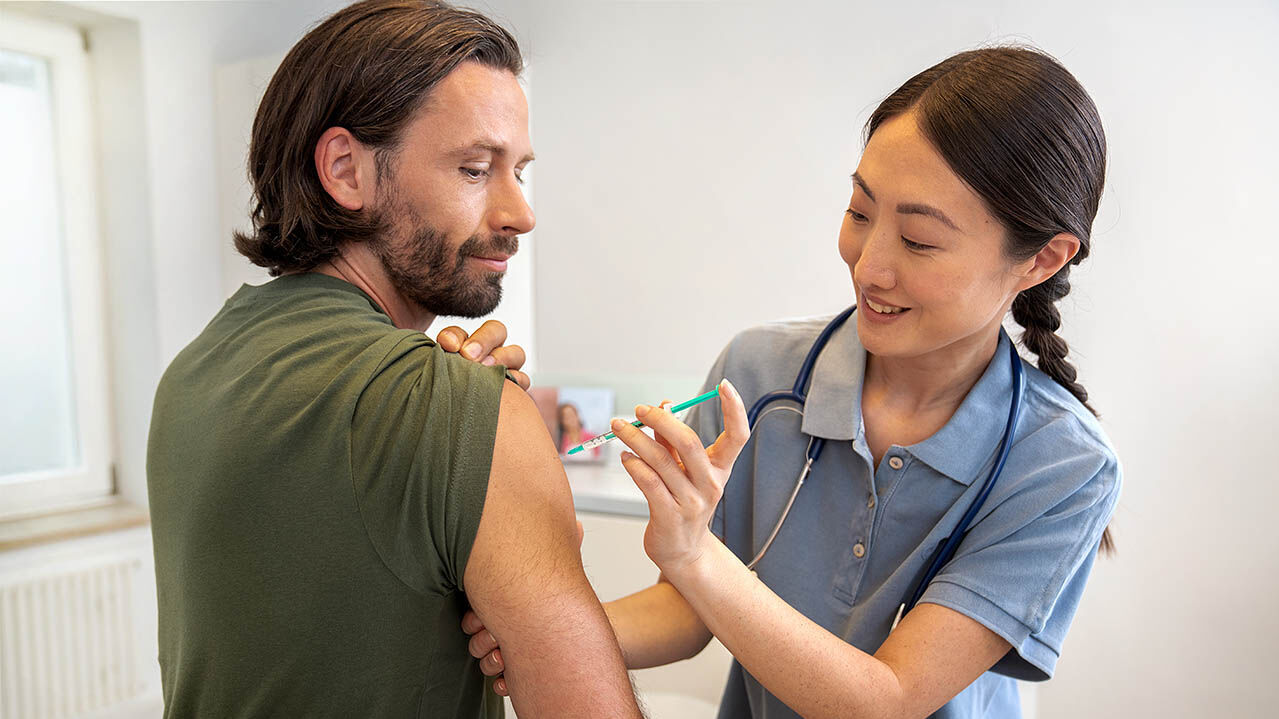
In Germany, there is a statutory requirement for certain groups of people to be vaccinated against measles. On this page, you can find out who is required to be vaccinated, how proof of vaccination can be provided and the background to the compulsory measles vaccination.

  • What is measles?
  • How can you protect yourself against measles?
  • Who is the vaccination suitable for?
  • Which vaccines are available?
  • What side effects may occur?
  • What costs does SBK cover?
  • Where can I get myself or my child vaccinated?
  • Frequently asked questions
  • Questions about the pathogen and the vaccination
  • Eine Patientin sitzt auf einer Liege im Behandlungsraum und bespricht mit einer Ärztin ihre Behandlungsergebnisse.

    Measles vaccination – your benefits

  • SBK reimburses the costs of the measles vaccination for unvaccinated individuals born before 1970 as an additional benefit.
  • The SBK Health Hotline provides round-the-clock advice if you have any questions about the measles vaccination.
  • What is measles?

    Measles viruses are highly contagious and are transmitted from person to person via respiratory droplets. A measles infection begins with flu-like symptoms such as fever, a cough and a runny nose, followed later by a characteristic rash. Although measles is considered a childhood illness, the disease can lead to serious complications such as pneumonia or encephalitis.

    How can you protect yourself against measles?

    The best protection against measles is vaccination, which is carried out in childhood with two doses of a combined vaccine. It is important to note that anyone born after 1970 who does not have adequate vaccination cover should catch up with a single dose.
    To avoid contracting the disease, contact with infected people should be avoided. 

    Who is the measles vaccination suitable for?

  • According to the Standing Committee on Vaccination (STIKO), the primary immunisation schedule begins with the first dose at 11 months of age (from 9 months if attending a childcare facility) and is completed with the second dose at 15 months of age (but no later than the end of the second year of life). 
  • The single standard vaccination using a combination vaccine is intended for people born after 1970 aged 18 and over who are unvaccinated, were vaccinated only once as children or have an unclear vaccination status.
  • The occupational indication for vaccination, comprising two doses of a combination vaccine, applies to people born after 1970 (including apprentices, trainees, students and volunteers) working in the following sectors:   
  • Medical facilities, including those for other healthcare professions 
  • Work involving contact with potentially infectious material
  • Care homes
  • Community facilities
  • Facilities providing communal accommodation for asylum seekers, persons required to leave the country, refugees and ethnic German repatriates
  • Technical colleges, vocational colleges and universities
  • Proof of immunity required – groups of people affected

    In future, the persons concerned must provide proof of immunity to measles, either by means of a certificate confirming that they have been vaccinated against measles or by means of a medical certificate stating, for example, that they have sufficient immunity as a result of a previous measles infection. The regulation applies to two groups of people:

  • People born after 1970 who are accommodated in a communal or care facility.
    These include, for example, children in after-school clubs, nurseries, kindergartens, schools and other educational establishments, residential homes or refugee accommodation. As the STIKO generally recommends the measles vaccination only from 11 months of age, affected children under 1 year of age are not yet required to provide proof. Affected children who are at least 1 year old must provide proof of at least one vaccination or of immunity. Affected children who are at least 2 years old must be able to provide proof of full immunisation (two vaccinations) or of immunity.
  • Staff born after 1970 who work in communal or childcare facilities as well as in medical facilities.
    This includes, for example, staff in after-school clubs, nurseries, kindergartens, schools, residential homes, refugee accommodation, hospitals, doctors’ practices, outpatient surgery centres, in the emergency services or in the care sector. Volunteers and trainees may also be affected by the regulation, provided they work regularly (not just for a few days) and for a longer period of time, rather than just a few minutes, within the facility.
  • People who cannot be vaccinated for medical reasons must have this exemption certified by a doctor.
  • If you are unsure whether you or your child is affected by the regulation, it is best to speak to your employer or the management of the childcare facility.

    Incidentally, anyone who cannot provide proof of a complete vaccination status is, in case of doubt, considered unvaccinated. Serological tests to determine immune status (measuring antibody titres in the blood) should be treated with caution. Incorrect laboratory results may lead to unprotected individuals being mistakenly classified as protected. 

    Which vaccines are available?

    In Germany, the only vaccines currently available for protection against measles are combination vaccines against measles, mumps and rubella (MMR) or measles, mumps, rubella and varicella/chickenpox (MMRV). These are also generally recommended by the STIKO. The compulsory measles vaccination requirement applies even if only the MMR vaccine can be administered.

    What side effects may occur?

    Swelling, pain and redness at the injection site are common after vaccination. Fever, irritability and a rash are other common symptoms following vaccination. Occasionally, enlarged lymph nodes, loss of appetite, a runny nose, crying, restlessness, insomnia, enlarged parotid glands, diarrhoea, vomiting, lethargy, malaise and tiredness may occur. Febrile convulsions, middle ear infections, coughs and bronchitis occur rarely. As there are various combination vaccines available, the frequency of side effects may vary, or some possible side effects may be missing from this list. You should therefore ask your GP about the risks and side effects.

    Please note: Pregnant women and people with severely compromised immune systems must not be vaccinated against measles. 

    What costs does SBK cover?

    SBK reimburses the costs of the measles vaccination for unvaccinated individuals born before 1970 as an additional benefit. In this case, please submit the private invoice from your GP practice, the vaccination prescription and the pharmacy invoice to us: upload these via the Meine SBK app or, alternatively, send them by post. You can find our  address and a prepaid envelope here. Your reimbursement will arrive in your account by bank transfer after a few days.

    Submit invoice

    Where can I get myself or my child vaccinated?

    If you have not yet been vaccinated against measles, you can get vaccinated at your GP practice, paediatrician’s practice or gynaecologist’s practice. For anyone within the STIKO’s recommended group, the practice can bill the vaccination via the SBK Healthcare Card. You will not have to pay any costs directly.

    Frequently asked questions

    Those affected must provide proof to the management of the relevant institution or to their employer that they have been fully vaccinated, have already had measles and are therefore immune, or that they cannot be vaccinated due to a medical contraindication. Proof must be provided in the following form:

  • Vaccination record or medical certificate, including as an appendix to the child’s health record booklet, confirming immunity to measles
  • A medical certificate confirming immunity to measles (for example, due to a previous measles infection)
  • Medical evidence that vaccination is not permitted for medical reasons (contraindication)
  • A certificate from a government body or the management of another institution covered by the Measles Protection Act, confirming that proof of immunity to measles or a contraindication was already provided in advance (this applies, for example, when changing childcare providers)
  • Failure to comply with the obligation to provide proof must be reported by the heads of the relevant facilities to the competent health authority. A breach of the provisions of the Measles Protection Act is regarded as an administrative offence and may be punishable by fines of up to €2,500. This applies equally to those in care and to staff who fail to fulfil their obligation to provide proof as well as to facility managers and organisations that employ unvaccinated staff or admit unvaccinated individuals in their care. In extreme cases, this may also lead to exclusion from facilities (provided there is no obligation to provide training or accommodation) and to bans on carrying out certain activities.

    Measles is a highly contagious disease. Consequently, almost any contact between an infected person and an unvaccinated person can lead to infection – even at a distance of several metres. However, in addition to typical symptoms such as fever and a rash, the infection can have far more serious consequences. Many people are unaware that, in one in 1,000 cases, measles infections can lead to encephalitis, which in turn can result in mental disabilities, paralysis and even death. In rare cases, subacute sclerosing panencephalitis (a progressive inflammation of the brain and nervous system) can also occur several years after infection, and this condition is always fatal.

    Despite this risk, and although the measles vaccine is the only effective and lifelong form of protection, many people refuse to be vaccinated against the virus or simply forget to do so. Furthermore, unvaccinated people also put at risk those who cannot be vaccinated due to their age (particularly infants under 1 year old), pregnancy or health reasons (for example, severe immunodeficiency).

    Insufficient vaccination coverage has led to the measles virus making a resurgence across Europe, with cases on the rise compared to previous years. However, to completely eradicate measles, 95% of the population must be fully vaccinated (i.e. with two doses of the vaccine). The aim of compulsory vaccination is now to close existing gaps in vaccination coverage.

    Questions about the pathogen and the vaccination

    Information from the Federal Ministry of Health (in German only)

    Information on the measles vaccination from the Robert Koch Institute

    0800 072 572 572 50

    Mon - Fri | 8 a.m. - 6 p.m. toll-free within Germany 

    0800 072 572 587 00
    Mon - Fri | 8 a.m. - 8 p.m. toll-free

    Follow us on

    Instagram
    Facebook
    TikTok
    YouTube
    LinkedIn
    XING
    kununu
    Contact overviewConsultant searchBranch searchOverview of servicesApplications & formsPersonal consultantContributions & ratesFamily insuranceGet to know SBKMembership applicationRecommend SBKEmployeeExpatsWith familyTraineesStudyingSelf-employmentOnline services at a glanceLoginFrequently asked questionsTerms of use
    Cookie Settings Privacy Legal Information Gender Notice Accessibility Simplified Language

    We use required cookies, which are necessary for the operation of the website, in order to provide you with an optimal website experience. Additional cookies and technologies are only used if you agree to them. These cookies and technologies are used for statistical purposes and for other functions on the website:

  • Required Cookies
  • Statistics Cookies
  • External Services
  • By clicking on "Allow all", you accept this and the transferring of your data to third parties. For more information, including regarding the processing of data by third party providers, see your Settings and our Privacy Policy. You can decline the use of cookies or change your Settings at any time.

    Accept all Only required Change settings
    ID to request consent
    Privacy Policy
    Accept all Change settings