Dental treatments and fillings
Information on fillings, root canal treatment and periodontal treatment
When it comes to dental treatments, there is a difference between cavities, periodontosis and root canal therapy. This page presents the different dental treatments and fillings.
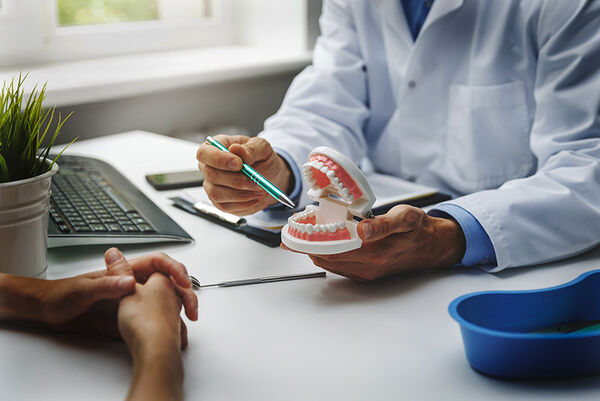
Treating cavities and getting fillings
If your dental treatment reveals that you have tooth decay, your dentist will remove the diseased tooth substance. He or she will preserve as much of the healthy tooth substance as possible. The missing substance will be replaced with a filling. There are various materials available for this purpose. You can read about these in detail in the following section.
Overview of cost coverage for dental fillings
There are a variety of materials with different properties available for dental fillings. Your dentist will be happy to advise you on the materials that are suitable for your teeth.
Depending on the material, you may incur costs. The amount of these costs depends not only on the material but also on the size of the filling. Your dentist will inform you of your share of the costs for the selected filling before the treatment. If, for example, you opt for a tooth-colored composite filling in a molar, the price for this is approximately twice as high as for a classic plastic filling. Depending on the size of the filling and the amount of work involved, you will incur costs of at least €40 per filling.
If you decide to have a filling with a co-payment, you will receive an invoice for this co-payment after treatment, which you must pay yourself. The dental practice will bill us directly for the portion of the costs that we cover using your SBK health card.
The most well-known filling material to date has undoubtedly been amalgam. However, its use has declined significantly in recent years. The European Union's ban on the use of dental amalgam in fillings came into force. The ban was imposed for environmental reasons. Existing amalgam fillings do not need to be replaced immediately.
What filling materials are available?
Dental fillings without co-payment must be made of so-called self-adhesive (self-bonding) materials. The front teeth up to tooth 3 are excluded from this. These include, for example, (plastic-modified) glass ionomer cements, glass hybrids, or self-adhesive composite hybrid plastics.
A co-payment is required for dental fillings that are significantly more time-consuming to apply, such as composites or gold or ceramic inlays. Your dentist will explain the various options to you before starting treatment. In this context, you should also mention any known allergies so that your dentist can take this into account when selecting dental fillings.
Root canal treatment
If your pulp is inflamed and cannot heal on its own, your dentist will try to save your tooth with root canal treatment. This involves removing the diseased pulp, cleaning the root canal, and then sealing the inside of the tooth with a filling. This is often a lengthy treatment, as several sessions are frequently necessary. If your root canal treatment is medically necessary and your tooth can be saved by the treatment, your dentist will bill the costs to your SBK health insurance card.
Periodontal treatment
Do you suffer from bleeding gums even with minor stimuli such as daily tooth brushing? Then you may have periodontitis, also known colloquially as periodontal disease. The gums detach from your teeth and so-called gum pockets develop. If your dentist recommends periodontal treatment, they will apply to us for coverage of the costs. You will usually receive approval a few days after we receive the documents. This means that we have agreed to cover the contractual treatment costs.
The scope of services covered by periodontal treatment has been significantly expanded. Services such as patient-specific oral hygiene instruction, evaluation of findings, and supportive periodontal therapy, including teeth cleaning following the treatment phase, are now included in the services that can be billed to SBK as part of approved periodontal treatment.
Bite splints
Headaches and muscle tension in the neck area can be the result of constant clenching or grinding of the upper and lower teeth. In addition, this can cause severe damage to the periodontium and chewing surfaces. Bite splints (also known as “grinding splints”) provide protection and relief and are covered by SBK.


